




Are you sure to delete it?












PRODUCT INFORMATION
Product performance complies with the requirements of JC/T 2326-2015 Q Ⅱ type. Specific technical parameters are as follows:
|
NO. |
ITEM |
Tecnical Requirement |
|
|
1 |
Consistency /mm |
As agreed by supplier and user |
|
|
2 |
Operational Time |
Consistency difference after 60 minutes/mm |
≤10 |
|
3 |
Workability |
No curling, falling off, or sticking to the trowel |
|
|
4 |
Crack resistance |
No cracks |
|
|
5 |
Tensile bond strength /MPa |
≥0.5 |
|
|
6 |
Shrinkage/(mm/m) |
≤3.0 |
|
|
7 |
28d Flexural strength |
≥2.0 |
|
|
8 |
28d Compressive strength/MPa |
≥6.0 |
|
The product also complies with the requirements of GB/T 25181 DP-G M10. Detailed technical indicators are as follows:
|
NO. |
ITEM |
Tecnical Requirement |
|
|
1 |
Water retention /% |
≥99 |
|
|
2 |
Setting time /h |
3-12 |
|
|
3 |
Consistency loss rate after 2 hours |
≤30 |
|
|
4 |
14d Tensile bond strength |
≥0.30 |
|
|
5 |
28d Shrinkage rate /% |
≤0.20 |
|
|
6 |
28d Compressive strength /MPa |
≥10 |
|
|
7 |
Freeze-thaw resistance |
Strength loss rate/% |
≤25 |
|
Weight loss rate/% |
≤5 |
||
APPLICATION PROCEDURE
Substrate Treatment
· The substrate should be clean and meet the flatness requirements for crack-resistant plaster (within 5mm deviation under a 2-meter straightedge). Remove any loose particles, dust, grease, or other contaminants.
· Concrete shear wall surfaces should be roughened, and plastering should be done after the roughened layer has fully hardened.
· High-absorbent substrates, such as aerated concrete block walls, should be treated with VASA PMC series primers. After the primer has dried, proceed with leveling plaster. The dilution ratio of the PMC series primer should refer to the specific product manual.
· Substrates like ceramsite bricks, concrete hollow blocks, and ordinary clay hollow bricks need to be thoroughly cleaned. Before plastering, the surface should be moistened adequately without visible water on the surface.
· Plastering should be done after the masonry or main structural works have passed inspection. Defects in the substrate and reserved grooves should be repaired in advance.
· For the junction of different substrates, use alkali-resistant fiberglass mesh to reinforce. The width of the mesh should be at least 250mm, with an overlap width of no less than 100mm for each substrate.
Mortar Preparation
· Refer to the certificate for water addition range.
· For manual application: Add water to the mixing bucket first, then slowly add the powder. Mix rapidly with a mechanical mixer until even, let it stand for 3 minutes, and then mix for another 10-15 seconds before use. The prepared mortar must be used within 2 hours. Do not add water to mortar that has begun to harden.
· For machine spraying: Check the equipment, connect the power and water sources, add the powder to the hopper, start the equipment, and open the spray gun. Adjust the water addition according to the mortar consistency until the output consistency is suitable for spraying.
Leveling Application
· Setting screeds: Before plastering, set the screeds on the wall. For walls less than 3.5 meters in height, vertical screeds should be used, with a spacing not exceeding 1.5 meters. For walls higher than 3.5 meters, horizontal screeds should be used, with spacing not exceeding 2 meters.
· Manual plastering: For large surfaces, apply the plaster in multiple layers, starting from the corners and working towards the center. The plaster thickness should slightly exceed the screed thickness by 1-2mm. Use a leveling board to scrape the surface evenly from bottom to top. The application thickness should be 5-10mm.
· Machine spraying: The spray gun should be perpendicular to the wall, with a distance of 100-200mm from the surface. Spray from top to bottom, starting from the corners and working towards the center. The application thickness can be completed in one pass for a thickness of 5-15mm. The spray thickness is slightly higher than the thickness of the punching strip by 1-2mm. After spraying, use a leveling board to scrape the surface evenly from bottom to top.
Curing
Under normal conditions, the crack-resistant plaster should be allowed to cure naturally. If the ambient temperature is above 35°C or the plaster is applied outdoors, water curing should be carried out after the plaster has hardened. The curing period should be no less than 7 days.
TECNICAL INFORMATION
|
Packing Specification |
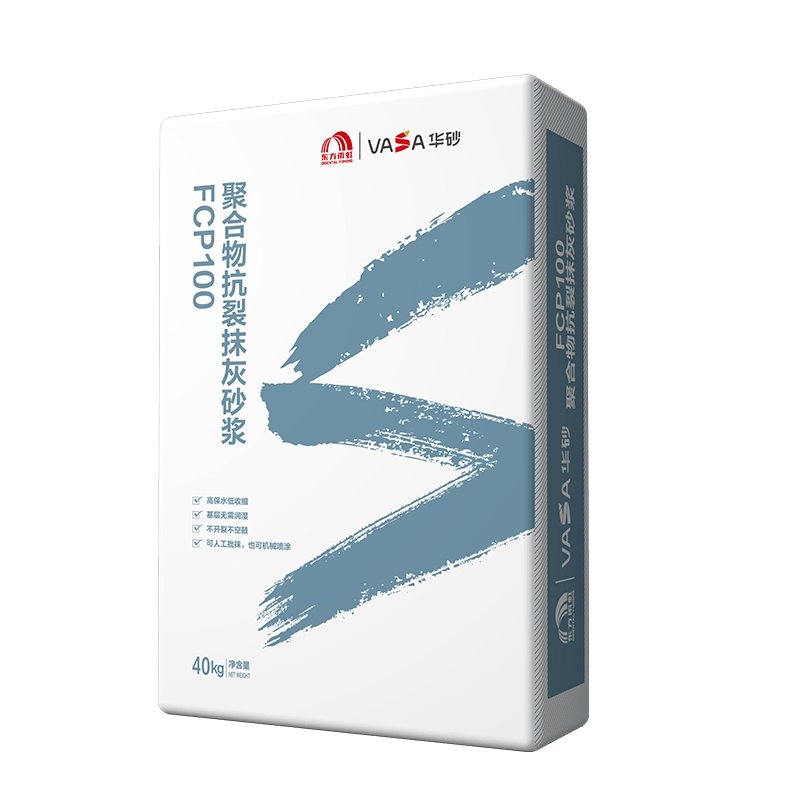
Bagged, 40kg/bag |
|
Color |
Gray |
|
Executive Standard |
GB/T25181-2019 "Premixed Mortar" and JC/T 2326-2015 "Building Leveling Mortar" |
|
Shelf Life |
6 months when stored in a cool, dry place in unopened packaging. |
|
Operational Time |
2 hours |
|
Operable Environment |
Temperature 5-35°C. Construction shall not be allowed on rainy days and strong winds above grade 5 |
|
Consumption |
1.5-1.6kg/m²/mm |
FEATURES AND BENEFITS
· One-time forming of thin plaster layers
· High water retention with low shrinkage
· Crack-resistant with no hollowing
· Suitable for manual plastering or mechanical spraying
This product is primarily used for leveling plaster layers with a thickness of 5-10mm on interior and exterior walls and ceilings. It is particularly suitable for leveling walls before applying decorative tiles or panels. Substrates can include concrete, aerated blocks, cement mortar, and hollow brick masonry.
 One-time forming of thin plaster layers
 High water retention with low shrinkage
 Crack-resistant with no hollowing
 Suitable for manual plastering or mechanical spraying